As the norm, media is and has been for centuries, created
for male consumption. Because of this standard the way images are presented
with “woman as image, man as bearer of the look” according to Laura Mulvey's essay Visual Pleasure and Narrative Cinema,
places women in an objectified position. This inundation of media presented in
this way affects society in many ways including perpetuating the patriarchal
system.
When looking for examples of the male gaze in media you
don’t have to look very far. While media that is targeted to men are certain to
be show this gaze...
Those that are targeted to women also mimic this formula of woman as object.
By contrast the oppositional gaze as described by Bell Hooks comes from the other end of the spectrum, the viewer being a black female as opposed to the white heterosexual male normative. This perspective is a result of the the under and misrepresentation of the black female, portraying her as someone who is inferior, uneducated, a nag, overly sexual, among other things. An indie artist, Chapter, made a satiric music video that demonstrates this.
This is a satire video but may not be viewed as such by many who buy into the media's portrayal and will see this as a proof that they are right. Which makes combating these types of stereotypes so much more difficult.
Being aware of these structures makes me wonder why this isn't discussed more often. Why do we as a society accept these roles? They are so ingrained in us that we don't even think to question them.
In our media today there tends to be a certain perception that we can see through what we can obtain. Although this is for many people a matter of what perspective they tend to take when viewing a product. A method that is commonly used in the media that tends to let people lean towards a certain perspective is the male gaze. The male gaze is typically seen through the perspective of the male making it seem that what the audience is viewing is towards his perspective. Though male gazing can be seen in different perspectives. From the different perspectives of the articles such as bell hooks it seems that in our culture there seems to be a certain way that both genders should act and if don’t act accordingly to it people will see it as if you’re not a normal person. In the article hooks stated that when she didn’t adhere to the standing that society had given her she was beaten by her father. Her mother said “I tried to warn you. You need to accept that you are a little girl and girls can’t do what boys do.” (Hooks) In my opinion the fact that the way women and men are categorized in a number of different ways feels restricting. I think this because of the fact if a person doesn’t ac t like the way that their gender is stereotyped then they are ostracized by other people. This stereotyped is further embraced by our media because through the countless commercials and movies is showing a different way of how a guy or girl should look and act. Berger said that “the real function of the mirror was otherwise. It was to make the woman connive in treating herself as, first and foremost a sight.” (Berger) I think that Berger was trying to say that in our media women are treated as a looking glass to make people look at her. It seems like that the media would want to treat women in commercial to look like that they would get attention through this or that kind of product. An example of it would be in the movie pretty woman where Julia Roberts character used the money of Richard Gere character to buy stuff to make herself look different from herself to give the impression of a higher standing and making her more attractive. Although her character isn’t the best example of this another would be in commercial in which celebrities are leading people to buy their product for the reason of their fame and that they might get attention from wearing that product. Oppositional gaze tends to specify towards race and the portrayal of how race is depicted in our media. Bell hooks in the article had shown an example of how African Americans were not depicted correctly by the media. The media had portrayed them as if they weren’t intelligent and as misfits and an example of this was the Amos and Andy show. According to the hooks article hooks stated that shows like Amos and Andy were for visual pleasure. (Hooks)The show was a depiction through the use of stereotyping a particular race. This doesn’t just apply to one race because in the media advertisers, writers and producers tend to stereotype about certain people either in race or in social standing. Though in our media today there are still products that still use the concept of oppositional and the male gaze to draw in the viewer. In many ways at first we don’t realize it but I think that gradually as we get exposed to it we tend to see how each different movie or commercial tends use these concepts. I think that after seeing the constant use of male and oppositional gazing that I am much more aware of it. Also, I think that by viewing it we can see why a company or a director would make that kind of choice to either draw the viewer to it or analyze why. Then it is through our own perception of the product that lets us determine why we either wanted the product or the fact that something like this can fool many people to buy one thing in order to buy their product. An example of this is would be from the picture that is shown with the model Kate Upton using sex appeal in order for viewers to buy a Karl’s JR burger. The choice for us is whether we want to buy this burger that the commercial is using a model as a way to make males buy the product.
"To be born a woman has been to be born, within an allotted and confined space, into the keeping of men." - John Berger
"One is not born a woman, but rather, becomes a woman." - Simone de Beauvoir
Here, Berger assumes that ‘woman’ is an all-inclusive concept. He posits that, all women go through this coming of age where they must submit to the male gaze (46). de Beauvoir predates him, and yet suggests that his first assumption is incorrect. Women become women by submitting to the roles presented to them by society. Therefore one is not born into that space but rather places herself there by accepting social norms. But does that mean if the male gaze is rejected, there will be no women? Does woman exist because the social ‘we’ accept that male exists? According to Laura Mulvey, as stated in her essay "Visual Pleasure and Narrative Cinema", the male gaze refers to the role of witness which we must all play as a result of the fetishization of the female body. She writes that, "A woman performs within the narrative, [while] the gaze of the spectator and that of the male characters in the film are neatly combined without breaking verisimilitude" (838). The idea is that, as consumers of art, we are forced to adopt the part of the voyeur. Mulvey further uses Alfred Hitchcock's overt play with voyeurism and scopophilia to clarify the concept. In his films, Hitchcock refuses to take the subversive route, one is forced not only to adopt the male gaze but to become to male gazing.
Pretty Little Liars, a telly show that sings praises to Hitchcock on a weekly basis, is targeted toward females between the ages of 12 and 34. It directly continues the trends that Mulvey defines in her essay. I would like to say that the male gaze still pervades popular culture because media is still produced by and for men but I'd be lying. In fact this show, which features a mysterious group of people continually spying on four teenage girls was created and produced by women based on a set of books written by a woman. [Why does the male gaze still pervade pop culture?] I honestly cannot that question.
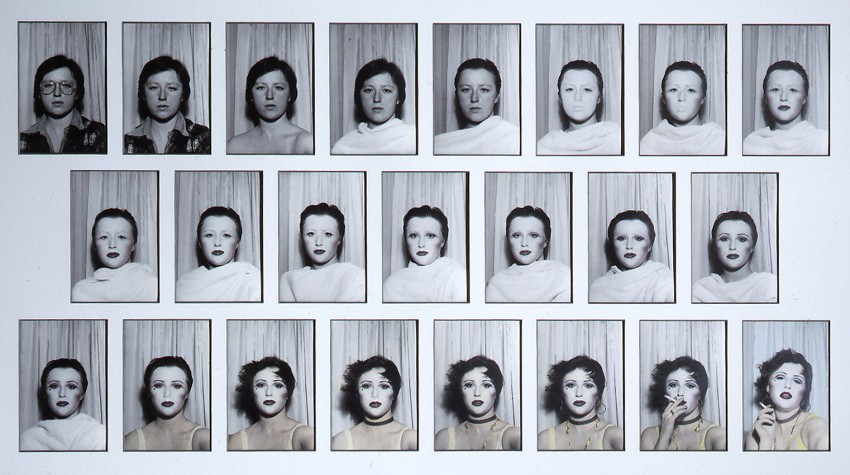
Last year I went to see the Cindy Sherman exhibit at MoMa. In transforming herself from the "female object" to "active male spectator", had she defied the notion of a male gaze? Is the voyeur still a voyeur when the image on display is not being watched but rather being shown? Are those meant for his consumption, or hers? The male gaze lives on because we don't question it. And then when we do, it's provocative, it's pornography, it's unwelcome. In his 1974 BBC documentary, Ways of Seeing, John Berger says,
men act and women appear. Men look at women. Women watch themselves being
looked at. This determines not only most relations between men and women but
also the relation of women to themselves. The surveyor of woman in herself is
male: the surveyed female. Thus she turns herself into an object - and more
particularly and object of vision: a sight (47).
The gaze. Feminist theorists talk about the male gaze, seethe about the male gaze, challenge the male gaze but they do so from their own personal perspectives. A black woman will never see the world the way another woman does, or so says bell hooks.
hooks defines a similar concept, “the oppositional gaze”, in her essay of the same name. She suggests that the oppositional gaze was forced upon black women because they were shown no one with whom they could identify. She then observes the gaze as a source of power rather than one which solely coerces submission. She argues that, “Black spectators actively chose not to identify...[and] were able to critically assess the cinema’s construction of white womanhood as an object of phallocentric gaze and choose not to identify with either the victim or the perpetrator” (122). Her opinion is strong, but her message not as widespread as one would hope... as I hoped. Today, where the black woman is missing in films and scripted television, she appears in the reality trash of our age, or on stage singing and rapping, or on the internet ripping bell hook’s precarious band-aid out of place.
Which one is a more realistic portrayal of a modern day "black woman"? Criticizing the disassociated portrayals is one thing, but how does one remain active when a body like hers enters the discussion, when she sees the new turn cinema has taken, when black women are thrown up on a screen for the male gaze as well.
I don’t fit in here, in this discourse. Not because I cannot, but because I don’t want to. When I watch a film, I never see myself on that screen. I rarely even see the characters. I see the story. It unfolds just as a book would. My “go-to” films are The Wizard of Oz, Funny Girl, The Rocky Horror Picture Show, Kinky Boots and D.E.B.S. I don't identify with any of those. In fact, none of those panders to the male gaze that Berger describes. RHPS puts everyone on display in a fantastical romp and D.E.B.S targets a specific female demographic. I acknowledge the existence of the male gaze because I think to deny it would be unwise, but I don't believe it wields the power that it once did. When we watch a scene shown in the objective point of view, we are given a choice. Most people tend to focus on what they think the director intended of them, but when you glance inside a window you look wherever your eye takes you. That is my take on cinema. I look only where I choose to, and issue challenges to the concept that “women [must] watch themselves being looked at.”
When I think of pop culture, advertising
and promotion, one of the first thoughts that comes to mind is “sex sells”. It
is sad and it is very true. Whether it’s on television or billboards in movies
or magazines, the ‘ideal’ female beauty is constantly displayed for all media
consumers, women and men, to see. Lately, it’s hard not to notice just how on
display a female’s sexuality is in all types of media content including racy
commercial advertisements, billboards, print ads, television shows, music videos,
and films. There is a ridiculous amount of influence from mass media to be
the most beautiful which puts pressure on every day women who are not
airbrushed supermodels.
The
male gaze is one which views women as objects, subjecting them to a controlling
and curious gaze. John Berger’s “Ways of Seeing” is about perception, the
placement and objectification of women. To be naked is to be vulnerable but a
female in the nude is what we see captured in old fine art, drawings, paintings
and sculptures like the Venus de Willendorf- she is faceless, voluptuous, she
could be any woman, but has no arms or feet. Without limbs she is trapped in a
static quality because she is unable to move. This furthers the ideology that
women are only to be looked at.Berger
explains in his article, “Women are there to feed an appetite, not to have any
of their own” (Berger, 55). Laura Mulvey in her essay “Visual Pleasure and
Narrative Cinema” cites the example of Marilyn Monroe and Robert Mitchum in the
1954 film River of No Return. “As the
spectator identifies with the main male protagonist, he projects his look on to
that of his like, his screen surrogate, so that the power of the male
protagonist as he controls events coincides with the active power of the erotic
look, both giving a satisfying sense of omnipotence” (Mulvey, 838). The
spectator is the male audience member who just bought the movie ticket and
wishes he were Robert Mitchum. Once Norma Jeane Baker bleached her hair, and
supposedly got a little nip and tuck she was transformed into the ever so
desirable, and now iconic, Marilyn Monroe. She was a shiny object on display at
a toy store.Monroe knew she had a male
audience and knew how to keep their attention.She played the ditzy, dumb, beautiful blonde in films and then went on
to pose nude photos that would end up being published in Playboy in 1953. But
putting one’s looks/body on display is to do just that; just be a body to be
looked at, to feed but not be fed, to give and never take, to be passive rather
than active. Thus, such women become dehumanized because they are nothing more
than pretty faces.Women in film have
traditionally functioned as both erotic object for male characters and the
erotic object for moviegoers. The image of woman is fixed and held for the
pleasure of the male spectator. In the world we live in today, everything is about finding consumers and getting their money. Monroe's work made money. Her fans are the consumers. Consumers pay. People bought movie tickets to see films that Marilyn Monroe was in. People paid to buy a ticket and stare at and admire her beauty. On top of that, the male spectators/audience gets to live vicariously through the male love interest on screen kissing Marilyn.
As opposed to female as a sex icon
image, male characters require depth in order for spectators to identify. Men
are supposed to be the heroes who save the day and then get the girl. Think
about the number of times a day we see women in the media scantily clad in itsy
bitsy teeny weeny bikinis. Now think about how often you see a man in the media
in a speedo or just underwear (underwear ads aside).There’s not much of a comparison.While Axe cologne advertisements are pretty
steamy, the fact is that men aren’t nearly as exposed in the media as women.
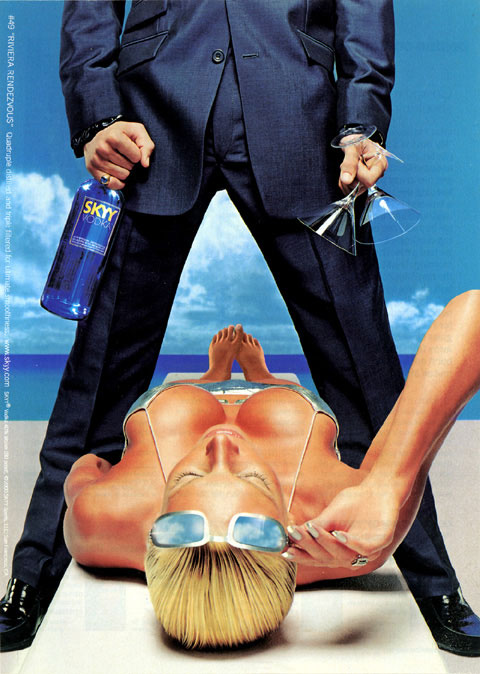
http://lindseyomelon.files.wordpress.com/2008/10/skyy3.jpg
This lady's breasts have nothing to do with SKYY vodka, but they are the first
thing you see when you look at the picture. The second thing I noticed was the
way he is standing over her. Classic case of 'sex sells'.
The
“Oppositional Gaze: Black Female Spectators” by Bell Hooks discusses the lack
of accurate portrayals of African American women in film. Shows on television
portraying African Americans, which are supposed to be relatable, often times
are not because those shows are being scripted, directed, and produced by white
people.In addition to inaccuracies,
early American cinema and television often portrayed African Americans as low
class, uneducated servants which only made the white female characters appear
more desirable on screen and ultimately to the male spectator(s). Listening to
Hooks speak during an interview, I felt I could relate to the feelings she
experienced as a young girl, not being able to relate to any characters on
screen or models in magazines. There were never any Indian girls on Full House
or Family Matters. As I got older and the industry started casting more
‘ethnic’ roles, the Indian Americans portrayed were all clearly extremely
traditional with tili on their foreheads and saris on every day. I am a first
generation American. Growing up I wore regular clothes like all my friends and
my family in America (parents, aunties, uncles and cousins) celebrated Easter,
Halloween, Thanksgiving, and Christmas. But this isn’t shown on television
because there hasn’t yet been a show centered around Indian Americans.
It
really is quite fascinating to think about and analyze ideas like the male gaze
and oppositional gaze, yet it’s simultaneously disappointing. I hope that the
recent trend of portraying racial and cultural diversity in the media (like on
Modern Family, and The New Normal) continues into the future and gives viewers
realistic and relatable entertainment.
In 1989 the Guerrilla Girls, an anonymous group of women dedicated to exposing sexism and racism in politics, the art world, film, and society at large, boldly asked, "Do women have to be naked to get into the Metropolitan Museum?" Their findings proved revealing, as the poster above shows. They have periodically updated this famous poster and in 2012 recounted and discovered the following:
The number of female nudes has decreased but the number of represented female artists has increased only one percent in the past few decades. The Metropolitan Museum of Art in New York City is the largest museum in the United States and one of the largest museums in the world, containing millions of works and years of prestige, tellingly has more female nudes than female artists. This study is limited to only the Modern Art section and if the entirety of the museum was included the number of female artists would be frighteningly lower.
These numbers reveal one of the many reasons why our vision of women and female objectification are so entrenched in our society. Previously female voices were underrepresented or squashed, leaving half of the population unheard and leading to the accumulation of literature, artwork, and media that to this day still does not equally feature both male and female works, opinions and ideas. As John Berger states in his book, Ways of Seeing, "To be born a woman has been to be born, within an allotted and confined space, into the keeping of men." The saying "it's a man's world" holds more power because throughout history the vast majority of institutions in European history have been lead, controlled, and expanded by men while their wives mainly controlled the domestic sphere. These wives were generally chosen based on their economic standing of their fathers and their physical attractiveness. "Menact, and womenappear," as John Berger notes.For centuries women in art and literature were rarely depicted as multidimensional creatures but as sights. For a clever satirical piece on this concept, both funny and disturbing in its truth, please click this link to read Teenage Girl Blossoming into a Beautiful Object.
The objectification of women is not simply an issue of the past because it can still be seen in society today from the media to fashion to politics. Recently I attended Alexander Wang's fashion show. It was my very first and I was incredibly excited by the opportunity. When I was a child I had considered going into fashion because of my own unique style sense and because so many people could envision me being successful in fashion because of this. However I ultimately decided that the field was not right for me. I was not comfortable with the idea that my appearance would constantly be placed under a microscope, harshly observed and scrutinized, and in such a competitive atmosphere too. The nostalgia that fashion brought made me curious, though. I had only been a part of the world through web articles, clothes shopping, and glossy magazine articles. What was the runway, the culmination of it all, really like?
Alexander Wang fashion piece,
image source Vogue
Going to a fashion show is 90% waiting and 10% actually watching the show. Once the lights dimmed and the music started thundering the models began their procession down the stage. But the models were irrelevant--the clothes were the focus. That is why some of the models had their faces covered as they walked, why they wore shoes that made me twinge with sympathy from my standing room position in the back. That is why the models all looked so sullen as they strutted from end to end in clothing worth thousands of dollars. Their bones jutted from their skin and I wondered idly if this lifestyle, the clothes and the camera lights, truly made them happy. The day was not meant for them it was meant for the audience, for Alexander Wang, the designer. In the few minutes it took them to circle the runway they were nothing more than the clothes they were wearing, objects more or less, because that is what we made them.
Models are not doing poorly financially if they are able to snag gigs like the Alexander Wang fashion show. Most go into modeling willingly and struggle to remain viable in an industry where looks really do mean everything. There are male models in the profession too and they are subjected to scrutiny as well. But the main issue is that often times these models are not subjected to the same form of objectification. This can be attributed to what Laura Mulvey notes in Visual Pleasure and Narrative Cinema, "According to the principles of the ruling ideology and the psychical structures that back it up, the male figure cannot bear the burden of sexual objectification. Man is reluctant to gaze at his exhibitionist like." Seeing large parts of the female body revealed in fashion is normal--plunging necklines or backs, sheer fabrics, long bare legs and more. But in male fashion the body undergoes a different treatment. The same can be said of advertising, film, comic books and other mediums. Male and female bodies are universally treated differently.
We do not hold men and women up to the same standard because the viewer/spectator has historically been assumed to be male. Only when the woman started to have her own disposable income did advertising to her become just as important as advertising to men. But this phenomena still does not eliminate the fact that we have now created two separate images --a male viewer and a female viewer--because we still separate the ideas of masculinity and femininity. We associate the feminine with subservience and weakness and until we accept both masculinity and femininity, female voices and male voices, male viewers and female viewers, until we no longer have to make these distinctions, women will continue to be objectified.
The first step is recognizing the difference and pointing it out to others. The second is encouraging more dialogue on how we can portray women as people, as human beings, not as objects dependent on their bra size or their willingness to be subservient. The third and most important step is to avoid preventing women from joining in on the conversation about their own bodies or limiting the venues they have to express these opinions. In this day and age the number of female artists in the Met should not be limited to 4%. As a society we can do better than that. In an ad to a movie that gained millions of dollars in revenue that tried to portray the female protagonist Black Widow as a strong female character they should focus on her strengths not the shape of her butt. This year marks the 40th Anniversary of Roe v Wade and the Women's Rights movement and the efforts of those women fighting for rights 40 years ago was just the beginning. It is up to this generation to continue where our mothers and grandmothers left off.
"Beauty is in the eye of the beholder"
In our society however, the media almost always produces works in which the spectator in mind is male. Thus the beholders of sight are men. This is the basis for what constitutes as the "male gaze". According to Berger, the sexualization of woman is the fundamental aspect of the male gaze. In modern paintings, magazines, artwork, films, and so on, just like in old historic paintings, the women usually pose in such a way in which they are looking right at the spectator, while offering her charm to him. The women of course doesn't know the man (or men) who will be looking at her, but she "offers up her femininity as the surveyed" (Berger, 55). In terms of looking on account of pleasure, the male engages in active looking while the woman is passive, she notices she is being looked at by the man and she must accept such a way (Mulvey, 837).
I found this image by searching "ideal woman" on Google. Anita Page is a perfect example of what an ideal woman was in the 1920s. The image details body part measurements on Anita and of course she was depicted as practically imperfect. She was blonde haired and blue eyed, and seen as the prettiest face in Hollywood during her stardom. Of course she was a perfect candidate for the reality of the male gaze.
An African American woman would of course never have been able to achieve the status and reception of Anita Page. Even today African Americans face much discrimination. They are exploited with a different kind of gaze, known as the oppositional gaze. The oppositional gaze is a critical and interrogating look towards blacks which is mainly concerned with issues of racism (Hooks, 117). Bell Hooks also states that these oppositional looks are rarely concerned with gender unlike the male gaze. While the woman in general is highly "marked" in the media, the African American woman was even more disgraced. She was considered inferior to the white woman (and to this day still is on account of modern racism).
I have always known of the existence of the male gaze, even if maybe just subconsciously on a day to day basis. It's come to a point where it's normal for a woman to be displayed sexually explicit in various media outputs and I would practically expect this to be the way media presented women. It always seemed highly logical to me growing up. I however also always considered this to be a problem ironically. I simply passively (or actively) accepted it as it is the norm in our society, but after learning of civil activist movements such as feminist movements and such I realized that the way in which the media operated highly undermined women in our society. They are almost nothing more than sex objects and while of course any straight man would be expected to enjoy such a reality, I find it to be a pathetic aspect of our society.
These readings helped me understand the severity of the problem further. I never really thought of that fact that even since very old paintings the women were portrayed as simply exhibits of sexuality and charm for men spectators. Also, I find it so awkward that so many movies that come out have women as appealing to every aspect of the male gaze. For example nearly every party movie always consists of male protagonists who set out to get the sexiest girls at their school or wherever. Meanwhile, approximately half of the income the movie industry makes has to be from women, as women constitute half of the human population. It just truly bothers me that so many people (especially considering women) just willingly and obliviously accept these facts of the media they consume. The media very effectively undermines and lowers respectable status for women and minority races in our society.
I would first like to say
that this class has already made me more perceptive to how certain aspects of
our society is actually structured and excuse my French, but it kind of sucks.
Perspective.
The male gaze is exactly
what we witness everyday. It is not just the magazines, movies, social media
outlets, but it is also the cat-calling in the streets, the constant “mirror
checks” on the subway, and the head-to-toe eyeballing of the women around us. I
originally wanted to write about how men are pretty much responsible for the
male gaze, but I think it is more interesting to also think about how women
contribute to it just as much.
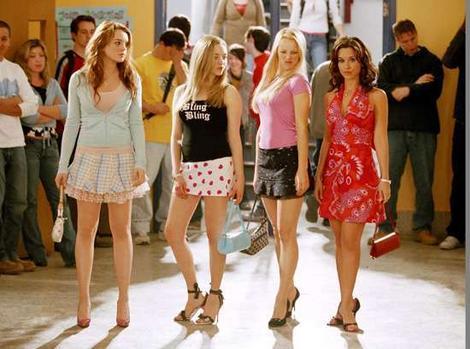
This picture is from the
movie “Mean Girls” written by the famous Tina Fey and I think it is the perfect
(although exaggerated) example of the kind of world that women live in. The
main characters, referred to as “the Plastics,” are the epitome of what all the
girls in high school want to be – pretty, popular, and what all the boys want.
This movie illustrates a concept Berger discusses: “From earliest childhood she
has been taught and persuaded to survey herself continually.” (46) In the
movie, all these high school girls constantly eye each other, judge each other
based on looks, and do what they can to catch the eyes of all these high school
boys. How messed up is it that even before high school, girls are actively
creating this kind of environment where they become the passive subjects of the
male gaze.
As an avid movie watcher,
I now look back on some of my most favorite movies and it is really interesting
to see how many of them are good examples of how the male gaze becomes a
reflection as he can easily identify with the main characters on screen. One of my favorite movies, Anchorman, is a comedy with a humor that can be considered offensive, but I feel
this one scene illustrates an idea that Mulvey brings up about how by being
able to identify with the confident usually male protagonist, the filmmaker is
“giving (the male viewer) a satisfying sense of omnipotence” (838). I think this is one of
the reasons the male gaze can be found everywhere – it is constantly
perpetuated in movies, television, etc.
On the contrary, women can
also identify with other women on screen. In bell hooks’ piece, she interviews
a black woman about her experience at the movie theater and she writes, “to experience
pleasure, Ms. Pauline sitting in the dark must imagine herself transformed,
turned into the white woman portrayed on the screen.” (121). With the
oppositional gaze being a misconception of the role of black women on screen,
hooks places the argument that in this way, black women are there simply to
accentuate the white actresses and is a way to “perpetuate white supremacy”
(119). This also connects to what Mulvey discusses is one of the central
pleasures of cinema – the ability to project one’s look onto the characters in
a movie. The question, however, remains to be: to what extent can women really
get a “satisfying sense of omnipotence” if the female characters are merely
supporting roles and even if they are the main characters, how they “…hold the
look, play to and signify male desire” (837).
In class we discussed the
topic of cat calling in the streets. From personal experience and what seemed
to be true for most of the women in class, it is not a pleasant feeling. I
would feel like an animal almost like a piece of meat put on display somewhere.
I recently came across the following picture on Tumblr and I found it ironic
that the caption read something along the lines of teaching our sons how to
respect a woman’s body. There are too many solutions to resolve these kinds of
issues and even then, I feel like each solution comes with their own flaws. For
example, I am definitely not one to say that women should dress conservatively
to avoid cat calling, but then others will also argue that women dressing
provocatively brings on the cat calling. Either way, I feel that it is going to
take the initiative from both parties to resolve these kinds of issues.
I am definitely much more
aware of how pervasive both the male and oppositional gaze are a part of our
everyday lives and it actually makes me a little more critical of all the media
I come in contact with – from YouTube videos my friends share on Facebook to
new movie trailers.