Thursday, April 25, 2013

Post 5 Bethany Si Yue Mong


     Mabel Cheung is a well-known female film director in Hong Kong. She graduated from the Hong Kong University. Also, she held an Advanced Diploma in Drama and Visual Arts from Bristol University in United Kingdom and an M.F.A. in Film Production from the New York University Graduate Film School. Mabel was the award winner of Asia-Pacific Film Festival in 1985 and Hong Kong Film Awards in 1986. Also, she was nominated for the Best Director in Hong Kong Film Award 1988, 1990, 1998, 1999…etc. She produced a lot of films which influenced the Asian culture.


     As a woman, Mabel Cheung loved to make films related to women. She also loved to make movies related to race, social and gender issues. “An Autumn’s Tale” is one of the most popular films directed in 1987 by Mabel Cheung. This movie was a love story between a man from mainland China who migrated to New York and a lady from Hong Kong who studied abroad in New York. Although they were both from China, they had culture and social conflicts due to their different backgrounds. However, they fell in love because of their understanding towards each other.

     Unlike mainstream movies, Mabel addressed stereotypes in a decent way, which was rare in the Asia mainstream media in 1980s. At that time, most of the Asians learned about New York from the mainstream media/ television. However, Mabel presented the least attractive part of New York in the movie, which shocked a lot of viewers. For example, she illustrated the main characters lived in a very old and unsafe neighborhood. Because the house was next to the subway station, the house would shake and things would fall down when the train passed by. Although this was an exaggerated example, it did help the viewers to reshape their ideas of what they thought New York should look like.


     However, Mabel also emphasized the American dream in her film. She illustrated how the main male character changed from a restaurant waiter who did not speak English to an owner of a seafront restaurant. And, the director also described how the main female character changed from an indecisive girl who cared   too much about her look to a person who was independent and dreamed to travel around the world. Camille Deprez, a writer of “Stacilee Ford, Mabel Cheung Yuen-Ting’s An Autumn’s Tale” said, “Ford subsequently examines how An Autumn’s Tale explores the myth of the American dream, which is generally associated with the opportunity to make it through individual effort, and goes beyond questions of assimilation in favour of a multicultural discourse.” This revealed the American society and showed how Mabel interpreted and presented her idea of Americans to her viewers.

     In “Beauty and the Beast of Advertising”, Jean Kilbourne said, “This is the real tragedy, that many women internalize these stereotypes and learn their “limitations,” thus establishing a self-fulfilling prophecy.” This quote reminded me of how gender roles changed our lives and how we viewed things. However, in “An Autumn’s Tale”, Mabel illustrated that genders were equal. Although women “internalize the stereotypes” given by the social, the media also did the same to men. In the movie, the main male character changed his bad habits and the way he dressed for the main female character. Also, he stopped cursing at people and fulfilled his dream because he wanted his girl to see his changes. This made me realized that stereotypes and gender roles in our society influenced both men and women equally. However, mainstream media was the reason why women were treated unfairly. I love this movie because this was very unique. It inspired me that everyone could make their own fairy tales even though in reality. Social norms and culture differences would not be problems in our lives unless we let them be.


Works Cited:
- Beauty and the Beast of Advertising, by Jean Kilbourne
- Stacilee Ford, Mabel Cheung Yuen-Ting’s An Autumn’s Tale, by Camille Deprez
- Youtube video about how Mabel Cheung made “An Autumn’s Tale”: http://www.youtube.com/watch?v=dIvamqDk7Vo (In Chinese)
Youtube video

------------------------------------------------------------------------------
Here is the full movie of "An Autumn's Tale" with English subtitles. Enjoy!






Post #5: Ellen DeGeneres


Ellen DeGeneres isn't your typical successful celebrity. She values honesty in her productions to show her real self to her audience. Currently, Ellen is the executive producer of her show The Ellen DeGeneres Show which aired since 2003. This is a late-afternoon-ish/daytime talk show where Ellen invited many famous celebrities to come talk about various topics. Her show is widely known for dancing, because Ellen loves to dance with her audience at the start of her shows. Ellen incorporates her production staff to the show by scaring them, surprising them, or sending them off to hunted houses (with Amy, writer of the show) before the audience members.


Although she is an enormously successful celebrity, her path getting throughout her career wasn't an easy one. According to BiographyEllen started as a stand-up comedian in 80's and slowly appeared in t.v. shows overtime. Show after show, Ellen gradually started to gain recognition for her humor and acting. During Ellen, which was probably the peak of her career since her debut, Ellen came out publicly in the 90's through the performance in her sitcom. The 90's wasn't the greatest period of time to announce homosexuality because this was when there weren't many openly-gay celebrities coming out publicly. Ellen took her many years to reveal herself to her audience because she feared that her coming-out would bring consequences to her life. Indeed, she was right. Afterwards, ABC was overwhelmed with criticism and backlashes for airing even after coming out publicly. The studio tried to appeal to the conservatives by putting disclaimer before the show aired to inform them that Ellen's homosexuality might be inappropriate for children. 

In "Commodity Lesbian" by Danae Clark, there appears to be several reasons why lesbian population are consider outsiders and not consumers of focus. Clark identifies the targeted consumer groups to be "1. identifiable, 2. accessible, 3. measurable, and 4. profitable" (Clark 143). In the case with Ellen, before Ellen came out, she focused in gaining viewers, popularity, and giving what the viewers wanted to see. According to Clark, she either might have done this to target the "main" consumer group, or to be targeted as the "main" consumer group. Clark's point is somewhat proven true because Ellen ultimately had her show cancelled after coming-out since she became an outsider and was not part of the "main" targeted group. Overall, Ellen transitioned from being an author to an auteur. The purpose and her intention of her career was to appeal to all audiences, but it seems that she works and creates her shows for herself. 

Debra Zimmerman said in Film Fatales that Trinh T. Minh (famous video maker) quoted, "If there was the choice between having her film show at New Directors [a prestigious, mainstream New York City film festival] and having it show in the New York Women’s Film Festival – if there were a New York Women’s Film Festival, which Women Make Movies might even be hosting (in the future) – it would be a very, very hard choice, because New Directors has that prestige value, which is extremely important for her” (Zimmerman 262). I find that Ellen was incorporated in part of the idea of being indecisive between fame and passion. As much as she wanted to be honest to her audience and to herself, it was very hard for her to select being truthful over fame and popularity. An interesting point is that although Zimmerman stated in a way that one cannot hold onto fame and passion at the same time, Ellen was able to obtain both, regardless. Being honest hurt her at first, but it really paid off after more and more people started to accept Ellen for her honesty and talent rather than her homosexuality.

In terms of her recent successes, Ellen's career has been taking off more than ever. According to Irish Central, two of the top TV personalities that are favored by republicans are Bill O'Reilly (of course) and Ellen Degeneres (really??). Even OnTopMag found that Ellen Degeneres was favored by republicans. This indicates that Ellen came a LONGGG way in her career. She broke a lot of barriers and stereotypes, and I find that this is a reason for her success. She didn't work to only appeal to conservatives (at the beginning of her career) or only liberals (after coming-out), but she worked to portray her true self, honesty. 

Personally speaking, I believe that the survey reported by Irish Central and OnTopMag really reflects the public. I grew up in a conservative family and a conservative nation. Homosexuality was absolutely unheard of back the 90's in South Korea. I'm assuming that any celebrity who came-out like Ellen would have faced severe consequences. However, my mother, who is also a devote christian and conservative (in terms of homosexuality), loves Ellen. This doesn't only pertain to my mother, but it seems as if many people like my mom forgets about the fact that Ellen's identity and is sucked into her charm and humor. I am curious to see how Ellen's career and influence will transition from here. It is very difficult for a woman like Ellen to be accepted by two opposite parties. However, she was able to obtain success and be truthful at the same time, and this is what I believe is the greatest talent that Ellen has.    


Reference

Danae Clark - "Commodity Lesbianism"


Redding/Brownworth - "Catherine Saalfield" and "Debra Zimmerman" from 

Film Fatales: Independent Women Director

Ellen Degeneres Biography - Part 1, Part 2, Part 3, Part 4

by IrishCentral Writer Staff, Irish Central

Wednesday, April 24, 2013

Post 5: Dee Rees and her film "Pariah" - Bruce Le


    Dee Rees is an American director whose film “Pariah” won the Excellence in Cinematography award at the 2011 Sundance Film Festival. Pariah is about a young African American girl who is dealing with her sexuality against a conservative mother who doesn't approve of her baggy clothes and male underwear. Dee Rees had a background in marketing before becoming a protege of Spike Lee at NYU's graduate film program. She used her own experiences with coming out as a lesbian to tell the story of the main character Alike. “It's something I lived as I was coming out. A big part of my struggle was not knowing who I was in the world,” Rees said in an interview with The Root.
    According to an article on the Huffington Post by Kia Makarechi, Rees had trouble pitching her movie to film studios and investors because of the existence of black and homosexual content. “We'd go to pitch meetings and the moment we said 'black, lesbian, coming of age,' they would turn around and hand us a bottle of water,” she told Makarechi. This supports the statement made by Danae Clark in “Commodity Lesbianism” that most advertisers have had no desire to identify a viable lesbian consumer group. Clark wrote that the association with homosexuality would be seen as negative by advertisers and they would be repelling the heterosexual consumers.

    The film has won 25 awards so far. The Huffington article went on to say that Hollywood expects writers of color to produce only work that concerns ethnicity-specific experience. This is what Rees was up against and what other filmmakers are up against. They expect you to conform and not push the boundaries of society. Rees said she had to sell her apartment so that potential investors could see how much she had committed to this work. The funding for gay media is abysmal compared to straight films. “Often, you have to work for nothing, especially if you're doing something about AIDS or about being lesbian,” said filmmaker Catherine Saalfield in Film Fatales.
    Rees has been tapped to work on a new HBO series and a feature film called “Large Print.” She is auteur because the lesbian experiences that Alike went through in the film were similar to her own experiences. The decision was made for the main character to be black and female because Rees wrote the story herself. It was filmed in 18 days. The budget was relatively small at less than $500,000. Rees would not have left her stable marketing job for the life of a filmmaker if there was not some cultural value in her vision. Pariah resonated with many critics and audiences because it was a different image than what people were used to seeing.


Works Cited

Brownworth, Victoria A., and Barbra Findlen. "Catherine Saalfield." Film Fatales:     Independent Women Directors. By Judith M. Redding. Seattle: Seal, 1997.     261-
    65. Print.

Danae Clark. “Commodity Lesbianism.” Camera Obscura January/May 1991 9(1-2     25-26): 181-201;doi:10.1215/02705346-9-1-2_25-26-181


Alice Wu


      Alice Wu was born in California. She is of Chinese decent and was previously a software designer for Microsoft before becoming a filmmaker. For someone new to the movie industry with no prior experience, her debut appearance as the director and screenwriter of the independent film, Saving Face, was a hit. This film was a controversial movie about a lesbian Asian couple (Wilhelmina and Vivian) facing cultural and societal obstacles. Although the plot of this film may be obscure to some, there is a level of intimacy and desire of belonging that any audience can sympathize with. Saving Face was inspired by Alice Wu herself as a gay Asian women who faced much backlash from the Asian community. Her personal experiences very much guided the progress of this film. As the auteur and the author behind the scenes, Wu has a lot of power over what this film will ultimately be. A big reason why the film was so successful is because Wu did not write the script to cater to the mainstream audience. Her inexperience in the industry actually helped her immensely in creating a truly honest film that is not polluted by mainstream media. Bell Hooks states that movies "give the reimagined, reinvented version of the real”(1) but this film is one of the rare exceptions to that statement.
In a Times article, Wu reveals that she was approached by producers that suggested changing the script into having Caucasian characters or making the film about a heterosexual couple. She cleverly declined those offers which would have made the film gear towards mainstream media. This independent film is a great example of how successful and relatable alternative media can be. By sticking with her original ideas for the script, she made the experience completely genuine and believable. As a heterosexual Asian woman watching the film, I was still able to relate to the main character's hardships of family approval and acceptance. Wu's cinematic choices as the auteur and author flawlessly portrayed the Asian culture and the delicate relationships between all the characters.
Debra Zimmerman and Catherine Saalfield's Author/Auteur: Feminist Literary Theory and Feminist Film touches on the subject of mother/daughter relationships. Alice Wu's Saving Face has a very genuine depiction of this type of relationship. Wu does stick to the stereotypical dictatorship-like mother/daughter relationship. Instead, she makes the character of Ma vulnerable as well. The movie takes you on a journey of healing in which both Wilhelmina and Ma aid each other's emotional wounds. Yes, it sounds sappy but trust me, Wu does an exceptional job of making the experience so realistic. 
The most common critique that Alice Wu has received is her bold decision to create a film that disputes such significant factors in our society-sexual orientation, race, and gender. While some may admire her gutsy debut film, others such as film critic Eric Snider degrade her film as "only a slight variation on a theme we've seen much of in recent films, that of the gay person who comes out of the closet in a strict conservative environment." Critics aside, this film was received very well by the general audience. In the Saving Face reunion screening, Wu speaks of audience members of different ethnicities and ages that express to her how they were able to relate to the film. 
      More specifically, there is no doubt that this film provided a powerful voice for the gay community and for the Asian community as well. As a young Asian woman myself who occasionally struggles with the traditional ties of my culture, I saw myself in this film.  The positive audience reaction has every bit to do with Wu's position as both the director and screenwriter. I think that if she had only fulfilled one of those roles, the film would not have been as successful as it was. This only stresses the importance of not only the prep work of writing the script but also the execution of it which Wu so brilliantly performed. 


Alice Wu on "Saving Face"


"Saving Face" Cast Reunion

Sources:

Saving Face directed by Alice Wu
http://www.nytimes.com/2005/05/29/movies/29leib.html?pagewanted=all&_r=0 (New York Times article on Saving Face)
http://www.youtube.com/watch?v=4Qm0hAtCBP8 (Alice Wu on Saving Face)
http://www.ericdsnider.com/movies/saving-face/ (Eric Snider's Critique)
http://www.youtube.com/watch?v=xsxXbnphz-4 (Saving Face Cast Reunion)
Bell Hooks, Introduction Reel to Real
Debra Zimmerman and Catherine Saalfield, Author/Auteur: Feminist Literary Theory and Feminist Film

Post 5 (Ruslan Ivanov)


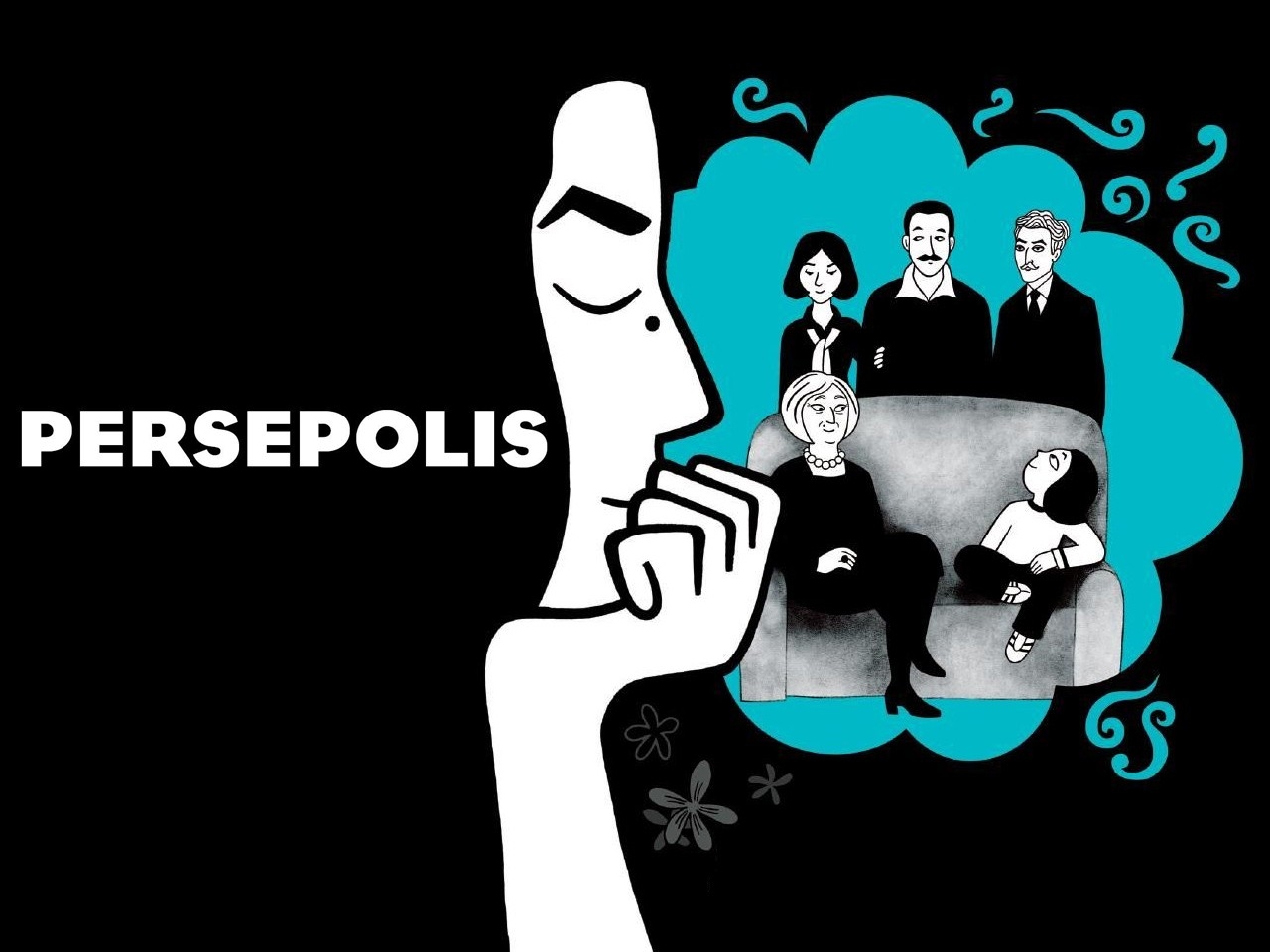
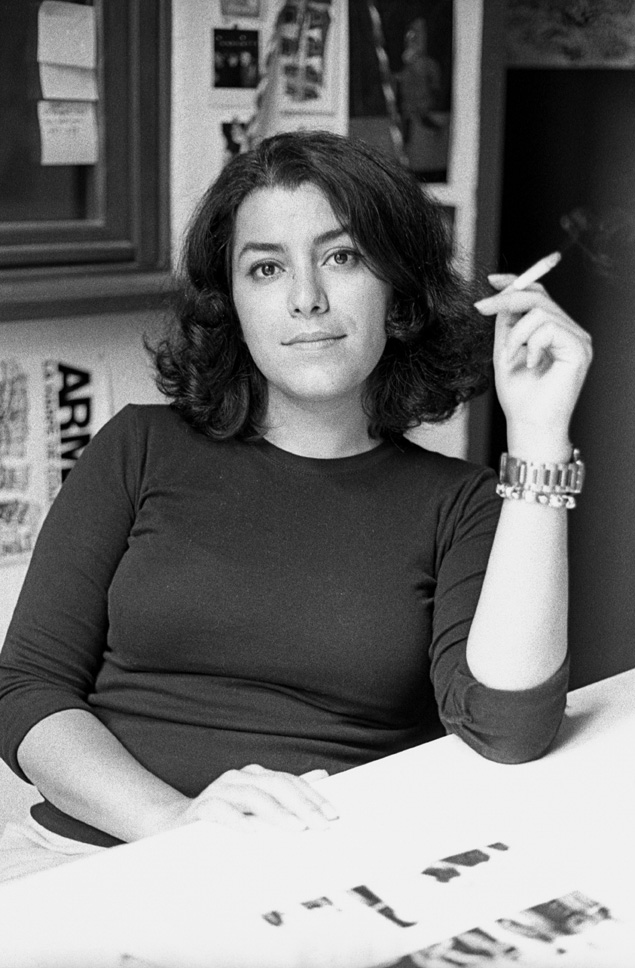
Marjane Satrapi is an Iranian-born French contemporary graphic novelist, illustrator, animated film director, and children's book author. Her name had never crossed my mind, until I saw her “Persepolis”. It is a film based on her book.  With the use of the series of monochrome drawings, she tells us a story of a young girl growing up in Tehran during the Iranian Revolution. The story is written in a style of a memoir and a very close depiction of the author’s real life. Satrapi was born in 1969 in Rasht and grew up in Tehran. She was raised in a highly educated atmosphere, where she was exposed to the westernized stratum of Iranian society. Growing up in a happy family, she spent her first 9 years surrounded by her independent minded parents and beloved grandmother, who was also her friend and a mentor. During her teenage years she became drawn to the pop and rock music, fashion and many other aspects of the Western culture until it all changed. After the Iranian revolution Iran turned into a hostile place for women. For someone who was raised on the principles of basic human rights, it was very hard to adjust in the new oppressive society. Therefore, Marjane quickly developed an attitude of a rebel.

Marjan’s parents became concerned with the future of their daughter living in the country with such strict behavioral codes for women. At the age of fourteen, Satrapi was sent to Vienna, Austria to attend French curriculum secondary school.  She had spent most of her teenage years in Europe. Living in the society different from the one she was used to, gave her an opportunity to experiment with her life. Unfortunately, casual sex, drug use and rock'n'roll didn't make her feel anymore accepted. She didn't feel like herself anymore. Eventually, moving from one apartment to another, she became homeless. After spending almost 2 month on the streets, she finally decided to return back to her home country. In real life, Satrapi also returned to Iran, where after several years she received a Master’s degree from the University of Tehran. According to the story, life in Europe only strengthened her oppositional views on human rights and freedom. She realized that Iran became even more inhospitable than she remembers. She had started attending numerous secret events in Tehran, in order to make her living bearable. In the age of 21 she got married but had divorced in about 4 years and permanently moved to Paris afterwards.
The main reason that made pick Satrapi as an influential artist is that she writes as both an insider and an outsider, she has that unique view of important historical and cultural change. In one of her interviews she said, “You know, the feminists become very angry when I say I am not a feminist. I am a humanist. I believe in human beings" (Thefword.org.uk), but even when she says that, I'm pretty sure most of us would be able to notice some  gynocriticism in her work. Maggie Humm described, “Gynocriticism is a way of assessing works of art specifically in relation to the interest and desires of women” (Humm 95). In “Persepolis” we can clearly see Satrapi’s concentration on Iranian women being targeted for modesty while the men remain relatively free, a rushed marriage, balancing cultural expectations with personal ambitions. There is a special representation of the veil, which plays a large part in lives of many muslim women. In “Persepolis”, I felt that Satrapi portrays the veil as something that meant to oppress the woman, make her submissive, passive and weak. I also think, her representation of the women helps breaking down the stereotype of Iranian women in general.
In “Feminism and Film”, Maggie Humm wrote, “Yet two relevant events suggest that the marriage of literature and film is one unlikely to be easily dissolved even if it is always in crisis” (Humm 90). In Satrapi’s case, there is no crisis at all. Satrapi took part in both writing the story and bringing it to life in film.  She personally drew all of the characters and passed them to the team of twenty designers and animators so they could create every angle, every motion and every facial expression of each character. Therefore, she is both an author and an auteur of the “Persepolis”.
Another characteristic of this production that made this film extra interesting for me is it’s style of animation. “Persepolis” is one of the few black and white films that is determinedly 2D, which separates it from many modern glossy animations. Satrapi describes the animation techniques as "stylized realism" (Parstime.com). She wanted the drawing to be completely life-like, not like a cartoon. Therefore, unlike a cartoon, production team didn't have that much of a margin in terms of facial expressions and movement. The whole film is hand drawn and consists of 600 distinct figures, from the lead characters to crowds of extras.  
Utilization of stylized and abstract graphics had allowed authors to reproduce very touching images of Satrapi's life, which on the other side, helped her to make a very bold statement upon human rights in general and showed the world the other side of Iran. Animators took advantage of clean, yet expressive lines when worked on characters eyes, mouth and gestures. Therefore, we are able to feel every bit of their emotions and many times, they are so convincing, they bring us to tears.
The setting of the film has also played major role in establishing the mood. There are few textures, mixed with shades and blots that are very stylized and plain. Animators also took advantage of using a contrast when changing the composition of the environment from dark to light.
       It is hard to underestimate the value of the “Persepolis”. This film has a storyline that is also intertwined with the political story. Not only we are living through Marjane’s struggles, we are also becoming involved. Use of film as political opposition allows the audience to break their stereotypical views on Islamic cultures as well as to become aware of the problem of the discrimination against women both in Iran and around the world.

Works Cited
  • Humm, Maggie. Feminism and film. Bloomington: Indiana University Press, 1997. Print.

Sunday, April 21, 2013

Performing Art(s)

I intended to write about Deepa Mehta, or Patricia Rozema, or Shamim Sarif, or Hanan Kattan. Filmmakers are easy for me. It is the world in which I invariably find myself trapped. I wanted to explore them, and their craft, and the reasons why Deepa Mehta has become my comfort zone. Then I saw that someone else has connected with her stories, and I remembered that I already divulged my love for Fire and Water in my previous post so I challenged myself to look elsewhere.

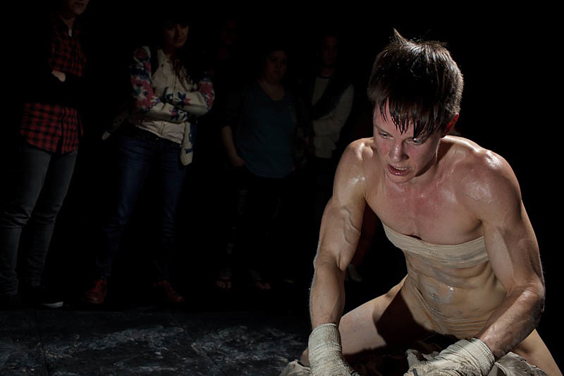
I arrived in New York a few months after The Artist Is Present exhibition at MoMa ended. I had no idea who Marina Abramović was. I had no idea why people were so emotional about the experience. I had no idea, and I never would because I had missed it. Performance art is live, unapologetic, palpable, experimental, memorable. Performance art is overlooked - by everyone, by me. If it isn't in your face, it doesn't have an impact. It is not film or video, it cannot be recreated. I tried to watch recordings of Ulay's visit to the exhibit but I couldn't feel it. I couldn't feel the weight of their reunion in my bones the way that it had been described to me. My retrospective glance at her eventually shifted to those who surround her place in history. Zackary Drucker and Heather Cassils use their bodies to make statements about institutions in ways that I have never seen before.


Heather Cassils appeared as a featured extra in Lady Gaga's short film/music video, "Telephone" where she caught the attention of the public with her gender bending. She works as a personal trainer but her passion is art. Her work seeks to critique the social laws that define gender. According to John Berger, in the text, Ways of Seeing: Based on the BBC television series, "To be naked is to be oneself [whereas] to be nude is to be seen naked by others and yet not recognized for oneself" (54). I think Cassils challenges that concept. In her performance pieces, she makes herself the naked subject who displays her body to present abstract concepts. She is neither naked nor nude by Berger's narrow standards.

\

In her book, Deadly Persuasion, Jean Kilbourne writes that, "Women are especially vulnerable because our bodies have been objectified and commodified for so long" (132). Although she identifies as gender non conforming, Cassils continually shows that the body is malleable; as are societal ideals and the gender roles prescribed at birth. The body does not make the person. It is such a simple idea but it is almost entirely absent in the American Media landscape. Artists like Cassils are an integral part of the messages that are dispersed daily. She reveals what the advertising industry, the social institutions that be, and our peers hide behind close doors. Through discipline the self can be divorced from the body to achieve the level of self-reflection necessary to transcend stereotypes, because unfortunately that's what conforming to social roles has become... stereotypical.


Works Cited

Berger, John. Ways of Seeing: Based on the BBC Television Series. London: British Broadcasting, 1977. Print.
Cotter, Holland. "Performance Art Preserved, in the Flesh." The New York Times 12 Mar. 2010, The Arts sec.: C25-26. Print.
Cassils, Heather, and Robin Black. "Artist Statement" LadyFace // ManBody. N.p., n.d. Web. 27 Apr. 2013.
Kilbourne, Jean. Deadly Persuasion: Why Women and Girls Must Fight the Addictive Power of Advertising. New York, NY: Free, 1999. Print.


Post # 5: Women Make Movies - Janis Mahnure


Rarely do I watch movies that move me. Sure, movies take me out of my own reality and into the “reality” of skinny girls and powerful men, but rarely do they put me in the reality of someone else, someone real, someone not glamorized, not edited, and not fictionalized. But the movie “Water” took me completely out of my own reality. It was very different from traditional movies and even traditional documentaries, and I felt a strange mix of melancholic but tranquil emotions after watching it.

I never thought about who makes the movies until I stepped into this class. Of course I knew majority of media was ruled by men – because honestly, the amount of women objectification should give you an idea of who controls media – but I didn’t realize that the movies I saw, which not always objectified women, were made by men too. So at first I just wanted to discuss how this movie explained the experience of a young widow in a genuine light, not glamorized, nor extremely poverty-stricken. When I went to do further research on the movie I was so happy to see that a women directed it.

Deepa Mehta is a Toronto-based director known for the Elements Trilogy: Fire, Earth, and Water. The film “Water” semi-epitomizes this notion of gynocriticism discussed by Maggie Humm in “Author/Auteur: Feminist Literary Theory and Feminist Film”. The film “involves a separate female way of thinking, and a recognition that women’s experience has been effecticly silenced by masculine culture” (Humm 95).

Humm delves into the separating of Author and Auteur in which the author is the one who writes the story but the auteur is the one who creates the story, gives it emotions and live, the auteur is the director. I felt that a story about a widow could go in so many directions. It can be completely scrutinizing of the culture in Indian rural area, it can be over emphasizing the religion’s elements involved, the story may remain the same but the director can change our perspective. Deepa Mehta however gives us a very unique eye. We see the tragedy, we see the confusion, we don’t understand this new style of living the same way the little girl doesn’t understand what fate that was thrust upon her. But we also see the patriarchy, we understand how tradition plays into this concept of widow, we see love, we see friendship, we see brutality, and we also see joy. It is not a one sided film to bring forth a horrible hardship. It does not end with her being free and being married and a happily ever after. It was simply her journey – with the good and the bad.

Deepa Mehta says that “All art is political, it's not personal. Somehow it reflects on the politics of our time. I don't see myself as carrying a placard with a message in my films. What motivates me are the stories.” During the making of Water, Mehta went through many obstacles. And these aren’t obstacles of funding but obstacles in which the people of india threatened to take her life – all over her filmmaking. “A party, Raksha Sangharsh Samiti (RSS) formed overnight specifically targeting Mehta. The KSRSS claimed themselves as the guardians of the culture of Varanasi and threatened her with violence. The RSS claimed that the world did not need to hear the problems of the widows in India and argued that Mehta has been poisoned by western influences and was simply looking for a story to sell (Yuen-Carrucan). The government intervened and let her produce the film at a different location. Deepa faced so much backlash for her other films, particularly that regarding sexuality in “Fire”. Hindu fundamentalists pressured the government to ban the film “due to it’s lesbian content and it’s commentary on the rights of women” (NYTimes).

A lot of the female directors I admire are actually from Toronto. I used have this “American pride, Canadian is dull” attitude, and when I went to Canada I actually still felt the same way; their water sucks, their train system is only two train lines, and they have little coins called loonies and toonies – like huh? But then I realized how women there are respected on another level. As a hijabi living in New York City, I’ve gotten very strange stares. To the point where I would feel so uncomfortable wearing it – that I would take it off. I’ve walked around without a hijab feeling accepted, feeling as if people felt more welcome to talk to me. But in Toronto I was actually wearing full burqa (head to toe in black) and I felt comfortable. I felt completely in place because there were so many hijabis in Toronto. At hunter, I feel comfortable because there are enough of us hijabis and we have our own little community. But when I step outside, walking around Times Square becomes almost strange.


I’m getting side tracked -- There’s a Canadian sitcom aired on CBC, “Little Mosque On the Prairie” which I discovered online and fell utterly in love with! It has a Muslim hijabi feminist whose father is Muslim and mother is a new convert who isn’t practicing. She is very active in the community and the show is adorable and funny and deals with a local mosque being shut down and then the mosque moving inside a church and the quarrels between community members both muslim v. nonmuslim and extremists v. modern muslim. Little did I know, it was created by a Pakistani woman, Zarqa Nawaz. Seriously though, why does Canada have all the best directors?

Here's a clip from the show when one of the characters doesn't want to wear hijab but her very conservative father is trying to make her wear it so this is her rebellion. Hilarious.

The whole show is on hulu. Can't wait to rewatch it all during the summer. :)


Work Cited:

Yuen-Carrucan, Jasmine. “The Politics of Deepa Mehta’s Water.” Bright Lights Film Journal. 10 Nov. 2001. Web
 Deepa Mehta Biography http://movies.nytimes.com/person/192088/Deepa-Mehta/biography. Web.
 Humm, Maggie "Author/Autor: Feminist Literary Theory and Feminist Film" Web.